Big Roll Twine for round bales

Length:
12,000 M

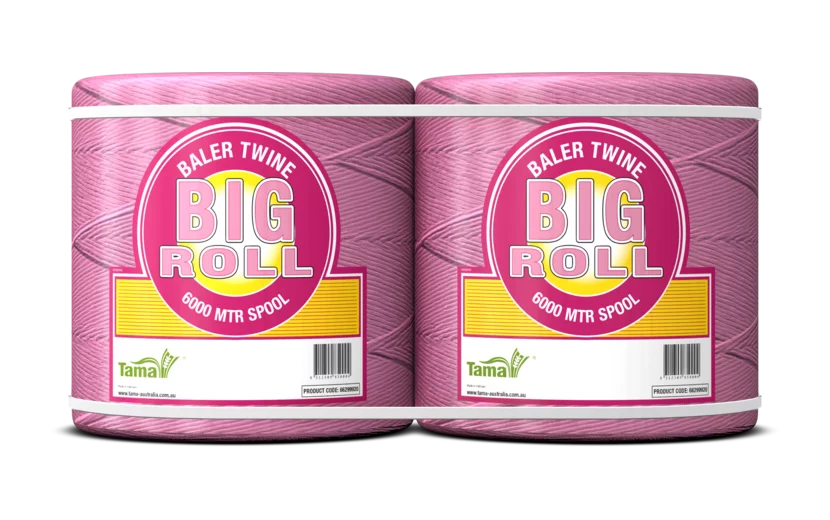
Part of the iconic Kinnears family of twines, Big Roll brings a long-established heritage to round baling. Its high strength and dependable performance help produce tight, compact bales while keeping baling operations moving.
The distinctive bright pink colour makes the twine easy to see in the paddock, on the bale and in storage, simplifying handling and transport. UV stabilisation supports durability in strong sunlight, while a guaranteed minimum length offers value in every pack. Big Roll is a trusted option when efficient baling and reliable results matter.
Big Roll Pink Round Baler Twine 6000m

Specifications

Product Name Length Colour Units per Pallet Selling Unit
Big Roll Twine for round bales
12,000 M
PINK
40
Pack
Product Name
Length
Colour
Units per Pallet
Selling Unit
Big Roll Twine for round bales
12,000 M
PINK
40
Pack


1 Products


Locate the nearest professional

Choose your category and State

Results (0) View All Experts

More ways we can assist

Service request Icon

Service request

Knowledge Center Icon

Knowledge Center

Training Icon

Training

Field experts Icon

Field experts

Questions about Twine?

We’ve got the answers

Questions about

Practical Baler Twine Tips
Large Square Baling
Pay close attention to bale pressure, taking into account the crop type and its condition. During prolonged hot, dry weather, for example, straw bales may be noticeably lighter than usual at the same baler pressure setting.
In these conditions, reduce the pressure setting or move to the next heavier twine.
For good-quality large square silage bales, follow these simple guidelines:

Ensure the crop has wilted to a minimum of 40-50% dry matter (DM) to produce well-formed bales and support excellent fermentation.
Reduce twine box tension as much as possible, as friction between silage bales during baling is much greater than between straw bales.
Remove as much air as possible during baling. Pack enough crop into the top of each bale to avoid misshapen bales that may be difficult for an automatic bale wrapper to handle. Reducing forward speed increases the number of wads per bale and helps achieve this.